
AI isn’t taking your job — companies are automating parts of roles
AI is driving cuts — but data and researchers say it usually automates tasks inside jobs, creating productivity gains and shifting skills, not immediate wholesale job loss.
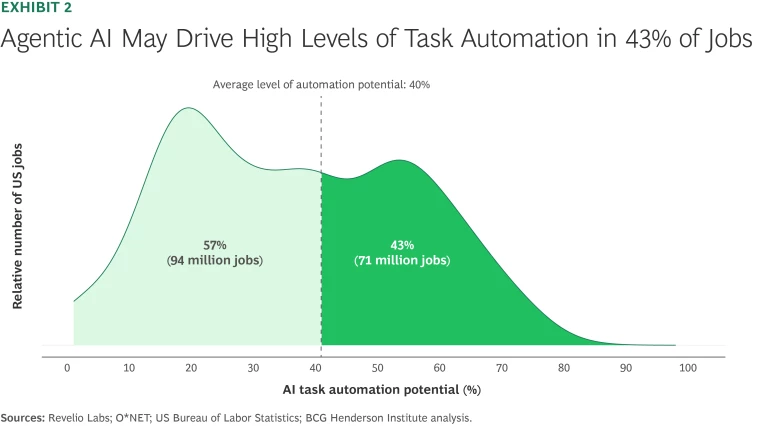
Companies are increasingly citing artificial intelligence as a reason for job cuts, yet firms and researchers say the technology more often automates tasks inside roles than replaces whole positions, reshaping work rather than erasing it.
That pattern shows up in recent data: according to reporting of Challenger, Gray & Christmas’s monthly tallies, employers have cited AI in more than 49,000 planned job cuts so far in 2026, and ranked AI as the top reason given for April layoffs for a second consecutive month.1 At the same time, McKinsey research estimates AI could technically automate about 57% of work activities — a figure that analysts say applies at the task level, not job level.2
Why this matters: the mismatch between task-level automation and headlines about “jobs taken” has real consequences. Firms tout 20–25% productivity improvements from AI tools while often retaining headcount, but that productivity can mask a reallocation of duties, new skills requirements and periodic rounds of targeted cuts in roles that are already narrow or routine.
Challenger: 49,000 layoffs cite AI in 2026
The month-to-month tally compiled by Challenger, Gray & Christmas — cited in a May 10, 2026 CNN report — places AI prominently in corporate narratives for cuts. That figure has driven alarm among workers and policymakers, partly because it compresses a wide set of corporate decisions into a single cause: sometimes cost-cutting, sometimes restructurings tied to AI pilots, sometimes both.3
Still, the same firms that cite AI often describe replacing specific tasks — invoice reconciliation, basic code generation, first-tier customer responses — rather than dismantling entire job families. That helps explain why some employers report fewer or different hiring needs rather than wholesale headcount reductions.
McKinsey: 57% of activities automatable — but ‘activities’ matters
The McKinsey estimate that roughly 57% of activities could be automated is the clearest quantitative anchor for the “not taking jobs wholesale” argument. The caveat is central: an activity is a discrete piece of work inside a role. Software that drafts routine legal clauses, for instance, doesn't eliminate counsel; it changes the distribution of work toward higher‑value tasks such as strategy, negotiation and client counseling.2
That task-level shift imposes a new demand: workers need to assess AI output quality, troubleshoot errors and bring judgment to edge cases. "With AI being used more and more, the skills that are actually required on the job have shifted," one manager told CNN. The point is not abstract — employers report asking for different resumes and testing familiar roles for new capabilities.3
Firms report 20–25% productivity gains; layoffs follow different logic
Vendors and consulting clients describe double-digit productivity improvements after deploying AI. Nitin Seth, cofounder of Incedo, told CNN some clients saw productivity gains “by at least 20% to 25% without reducing staff at the same scale,” as AI handled “certain parts of different roles.”3
That pattern—productivity plus retained headcount—underlines a tension. Independent labor economists caution that short-term hiring freezes, targeted layoffs and shifts in hiring profiles can presage larger workforce churn. A skeptical labor market analyst noted to CNN that companies have incentives to label cuts as AI-driven to avoid admitting other strategic failures; skeptics also warn that task automation can aggregate into job elimination over years rather than months.3
Companies selling large language models and developer tooling — from incumbent cloud providers to startups powering code assistance — are benefiting. Those winners are obvious. The losers will be workers in narrowly defined, highly routinized tasks unless employers invest in retraining, or unless labor market dynamics push wages up for remaining human-centered skills.
Looking ahead: watch the monthly Challenger tallies and the cadence of Q2 earnings calls, where CFOs often disclose the ROI of AI pilots and whether productivity improvements translate into hiring freezes, redeployments or further cuts. How firms balance productivity, reskilling budgets and public scrutiny will determine whether AI is mostly a tool that reshapes work, or a technology that ultimately removes whole roles over time.3
[[Internal Link: ChatGPT]] [[Internal Link: Anthropic]]


