
Google Introduces Gemini Tools for AI Chat Migration
Google introduces tools for Gemini AI, enabling users to import data from ChatGPT and Claude, easing platform migration.
Google Launches Gemini "Switching Tools" for AI Migration
Google has introduced new "switching tools" for its Gemini AI assistant, allowing users to import personal memories and full chat histories from competitors like ChatGPT and Claude. This move addresses a significant barrier to platform switching in the AI chatbot market. Announced via an official blog post on March 26, 2026, these features are now available to all personal Gemini users worldwide, marking a direct bid to capture users loyal to established rivals (MacRumors, Android Authority).
How the Switching Tools Work
The tools operate through two straightforward mechanisms designed for manual but seamless data transfer, without requiring direct API integrations with rival services.
-
Memory Import: Users access the feature via Gemini's "Settings and help" menu, selecting "Import memory to Gemini." Gemini generates a customized prompt—such as requesting a summary of preferences, relationships, interests, family details, or personal context—which users copy and paste into their current AI app (e.g., ChatGPT or Claude). The rival AI outputs a condensed summary, which users then paste back into Gemini. Once added, Gemini securely stores this data for personalized future interactions (MacRumors).
-
Chat History Import: For broader continuity, users export conversations from other platforms in ZIP format and upload them directly to Gemini, with a limit of up to 5GB. Gemini indexes the data, allowing users to search past threads and resume conversations seamlessly (Android Authority).
Google emphasizes privacy, stating that imported data is analyzed and stored securely within the user's Gemini account. No automatic syncing occurs; the process relies on user-initiated exports (Economic Times).
Google's Track Record with Gemini
Gemini, launched in December 2023 as Google's successor to Bard, has evolved rapidly amid fierce competition. Early versions like Gemini 1.0 faced criticism for factual inaccuracies, but Gemini 2.0 (released December 2024) topped benchmarks in reasoning and multimodal tasks, surpassing GPT-4o in areas like math and coding. Monthly active users reached 750 million by early 2026, trailing ChatGPT's 900 million weekly but closing the gap through Android integration and free access tiers (MacRumors).
Competitor Comparison
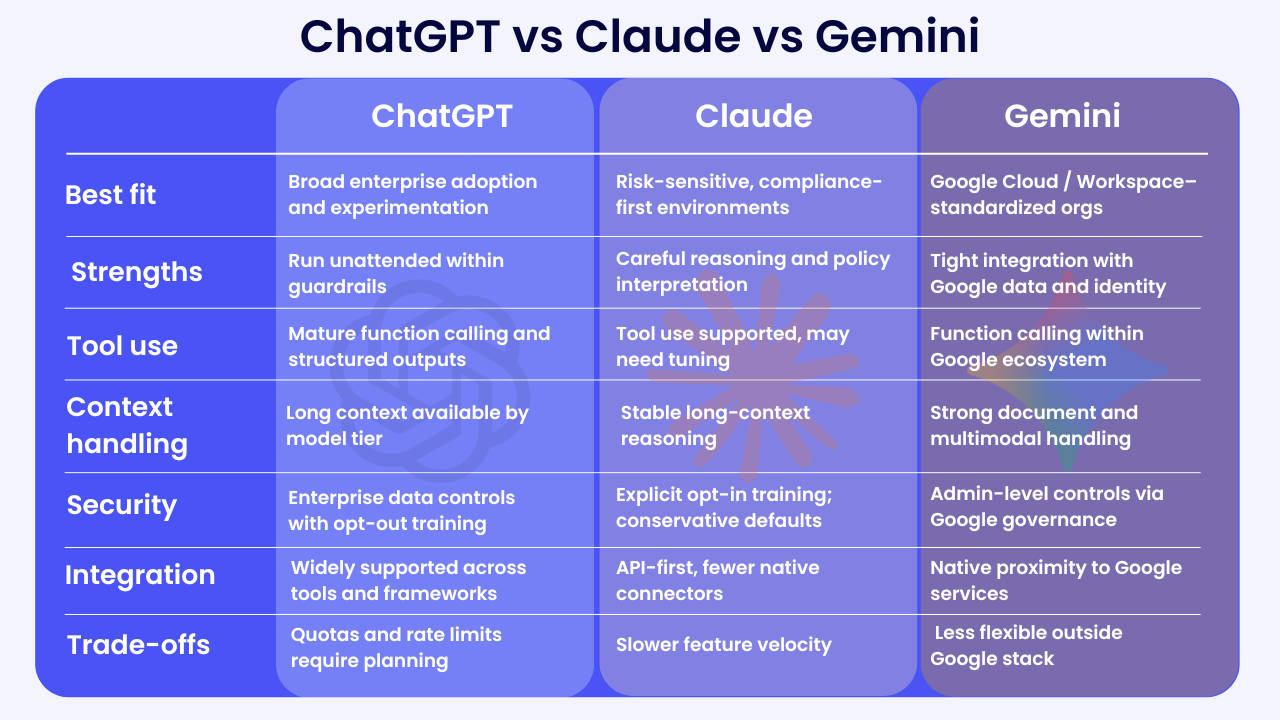
| Platform | Active Users | Key Personalization | Export/Import Support | Strengths | Weaknesses |
|---|---|---|---|---|---|
| Gemini (Google) | 750M monthly | Memory, Extensions; Now imports from rivals | ZIP chats (up to 5GB); Prompt-based memory | Deep Google ecosystem ties; Free tier | Lags in weekly engagement |
| ChatGPT (OpenAI) | 900M weekly | Custom Instructions, Memory | Full ZIP export | Market leader; First-mover | Paid memory for Plus users ($20/mo) |
| Claude (Anthropic) | Undisclosed | Constitutional AI, Large Context | Conversation export | Safety-focused; Strong reasoning | No native import tools |
Strategic Context and Market Timing
The rollout coincides with intensifying competition: OpenAI's GPT-5 rumors and Anthropic's Claude 4 threaten Gemini's momentum. AI lock-in via personalized data has become a moat—users hesitate to switch after investing time in training models. Google, with Gemini integrated into 2 billion+ Android devices, aims to convert the 80% of users still on ChatGPT by reducing "retraining friction" (Android Authority).
Implications and Critiques
This move could reshape the $200B+ AI assistant market by 2030, commoditizing personalization and spurring rivals to retaliate. Critics note limitations: manual processes risk incomplete transfers, and privacy concerns linger despite Google's assurances. Some call it a "desperate ploy," questioning if benchmarks translate to daily stickiness (Neowin).
Early adoption reports are positive, with Android Authority users praising seamless ChatGPT migrations. As AI personalization deepens, Google's aggressive portability play underscores a shift: from proprietary ecosystems to user-empowered fluidity.


