
Nvidia, Broadcom, and TSMC Lead AI Infrastructure
Nvidia, Broadcom, and TSMC lead AI infrastructure, providing essential hardware for AI growth. Investors are advised to focus on these giants over end-user apps.
Nvidia, Broadcom, and TSMC Lead AI Infrastructure
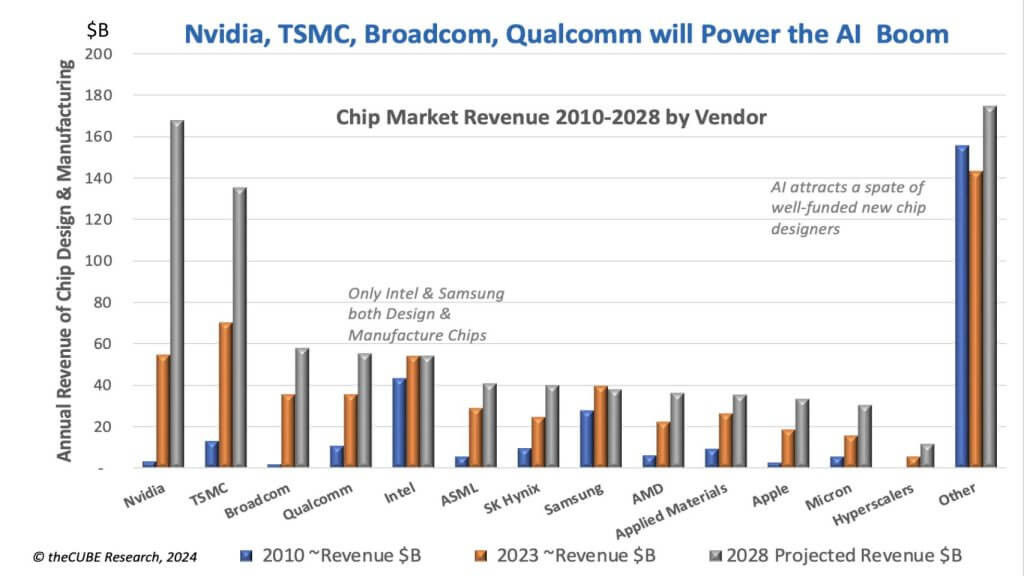
Nvidia, Broadcom, and TSMC are at the forefront of the AI infrastructure layer, providing the essential hardware that supports the rapid growth of artificial intelligence. While companies like SoundHound capture attention with their conversational AI technologies, these semiconductor giants are the backbone, offering GPUs, ASICs, and advanced foundry processes crucial for AI model training and deployment at scale. According to Yahoo Finance, investors are advised to focus on these infrastructure leaders rather than the hype surrounding end-user applications.
The AI Infrastructure Layer: Hardware and Software Foundations
The AI infrastructure layer includes hardware accelerators such as GPUs and TPUs, along with software orchestration tools and cloud services necessary for building and running AI models. As Red Hat explains, this layer integrates specialized processors, data pipelines, and scalable cloud environments, forming the backbone for enterprises deploying AI at scale.
Google Cloud's advancements with TPU v8t and TPU v8i chips highlight the evolution of this layer, offering enhanced performance for AI workloads. These units aim to optimize cost-efficiency and innovation, competing directly in the inference and training arenas dominated by GPU leaders (Google Cloud).
Market Leadership and Performance
Nvidia (NVDA) dominates the AI GPU market with over 80% share, thanks to its H100 and upcoming Blackwell series, which deliver unprecedented performance for large language models. Broadcom (AVGO) excels in custom AI ASICs and networking chips, supporting hyperscalers like Google and Meta. TSMC (TSM), the leading foundry, manufactures these chips on advanced 3nm and 2nm nodes, meeting AI's demands for density and efficiency (Yahoo Finance).
Image: Nvidia H100 GPUs in a high-density AI training cluster. (Nvidia) Image: Nvidia H100 GPUs in a high-density AI training cluster. (
Proven Track Records
These companies have shown impressive financial performance. Nvidia's stock surged over 200% in 2023, driven by AI data center revenue reaching $18.4 billion in Q3 2024 (Reuters). Broadcom reported $9.1 billion in AI-related revenue for fiscal 2024, while TSMC's Q4 2024 revenue grew 37% to $25.6 billion (Bloomberg).
In contrast, SoundHound's market cap remains under $2 billion, with Q3 2024 revenue at $25 million, highlighting the significant gap between infrastructure giants and niche players.
Competitor Comparison
| Company | Core Strength | Market Share | 2024 AI Revenue | Key Competitors |
|---|---|---|---|---|
| Nvidia | GPUs | 80-90% | $47B+ | AMD, Intel |
| Broadcom | ASICs/Networking | 25% | $12B+ | Marvell, Cisco |
| TSMC | Foundry | 60% | $30B+ | Samsung, Intel |
| SoundHound | Voice AI | N/A | $85M | Not infrastructure |
Strategic Timing in AI's Next Phase
The shift from AI training to inference highlights the need for scalable infrastructure. Hyperscalers like Microsoft and Amazon are increasing their capital expenditures for data centers, while geopolitical tensions drive onshoring efforts (Reuters).
Despite concerns about overvaluation, Nvidia's CUDA ecosystem, Broadcom's long-term contracts, and TSMC's process leadership ensure their continued dominance (Bloomberg).
Implications for Investment and Innovation
Investors focusing on infrastructure providers stand to benefit from AI's projected $1 trillion opportunity by 2030, as software layers become commoditized (McKinsey). These giants will continue to dictate the pace of AI advancement across industries.


