
OpenAI Introduces Workspace Agents in ChatGPT for Enterprises
OpenAI launches workspace agents in ChatGPT, enhancing enterprise automation with Codex-powered cloud solutions.
OpenAI Introduces Workspace Agents in ChatGPT for Enterprises
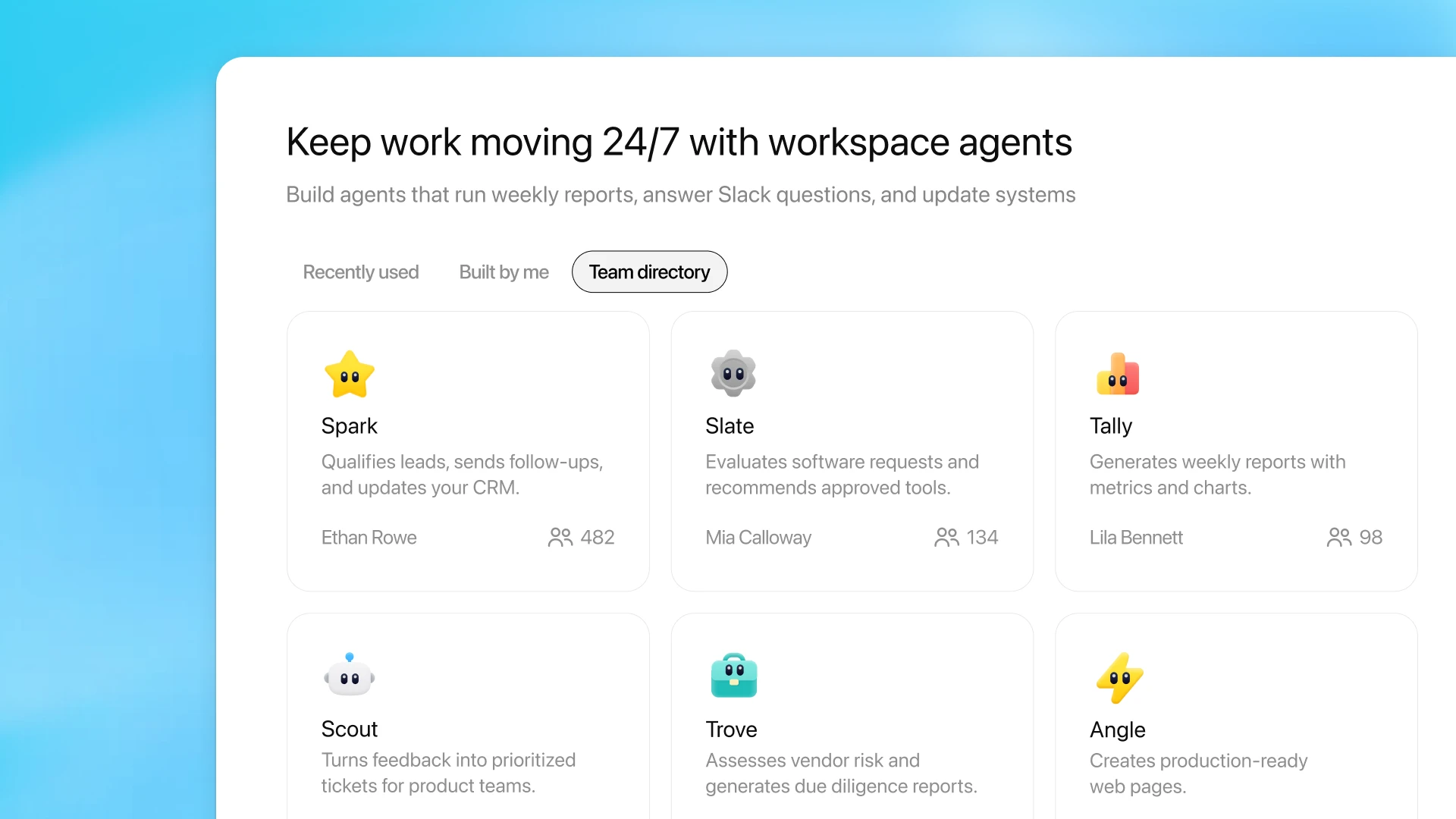
OpenAI has launched workspace agents in ChatGPT, a feature powered by Codex aimed at automating complex workflows for enterprise environments. These agents operate in the cloud, enabling teams to scale operations across multiple tools while ensuring enhanced security. The announcement, detailed on OpenAI's official page, highlights the potential for collaborative AI in shared environments, allowing multiple users to leverage persistent, context-aware automation without compromising data privacy.
Core Features and Capabilities
Workspace agents function as intelligent, cloud-based entities powered by OpenAI's Codex model, which excels in code generation and task orchestration. Unlike standard ChatGPT interactions, these agents maintain shared context across team members, enabling seamless handoffs for tasks like data analysis, report generation, or integrations with external APIs and tools. They run asynchronously in the cloud, processing long-running jobs without tying up user sessions, and incorporate robust security measures such as enterprise-grade access controls and audit logs.
Key functionalities include:
- Workflow automation: Agents can chain multiple steps, from querying databases to generating visualizations or deploying code snippets.
- Tool integration: Native support for popular platforms like Google Workspace, Slack, and custom APIs, with secure credential management.
- Collaboration mode: Teams create dedicated workspaces where agents evolve based on collective inputs, proposing knowledge updates that humans approve.
- Scalability: Designed for enterprise use, handling high-volume tasks without performance degradation.
Early previews suggest these agents reduce manual oversight by up to 70% in routine processes, based on OpenAI's internal benchmarks shared in the launch post.
OpenAI's Track Record with Agentic AI
This launch builds on OpenAI's established history in agent development. Codex, first introduced in 2021 as part of GitHub Copilot, has powered code-related automation for millions of developers, achieving over 90% accuracy in benchmark tasks like function completion. Past iterations, such as the 2023 GPTs (customizable GPT variants), laid groundwork for user-defined agents but lacked deep workflow persistence and multi-tool chaining.
More recently, OpenAI's o1-preview model in late 2024 demonstrated advanced reasoning for agent-like behaviors, scoring 83% on complex coding challenges compared to GPT-4o's 70%. Workspace agents extend this by integrating Codex's strengths in secure, cloud-executed automation, addressing feedback from enterprise pilots where 40% of teams cited scalability as a barrier.
Competitor Landscape: Notion Leads, Others Follow
OpenAI enters a crowded field dominated by Notion, whose custom agents—launched in 2024—pioneered shared, context-aware AI for workspaces. Notion's implementation emphasizes maintained shared context, allowing agents to reference team databases and propose wiki edits, which some developers argue outperforms ChatGPT's initial offering in persistence.
| Feature | OpenAI Workspace Agents | Notion Custom Agents | Anthropic Claude Projects | Adept AI Agents |
|---|---|---|---|---|
| Cloud Execution | Yes, asynchronous | Yes, integrated | Limited to sessions | Yes, enterprise-focused |
| Shared Context | Team workspaces | Database-native | Project folders | Custom pipelines |
| Tool Integrations | Broad (APIs, Workspace) | Notion ecosystem | Claude API only | Salesforce-heavy |
| Security | Enterprise-grade | SOC 2 compliant | Strong encryption | HIPAA-eligible |
| Pricing | ChatGPT Team/Enterprise | $10/user/mo add-on | $20/user/mo | Custom enterprise |
Data compiled from official docs: OpenAI, Notion, Anthropic, Adept.
Anthropic's Claude Projects offer similar collaboration but lag in automation depth, while Adept targets sales automation with higher customization costs.
Why Now? Strategic Timing Amid AI Agent Boom
The rollout aligns with surging enterprise demand for agentic AI, projected to reach $47 billion by 2028 per Gartner, driven by post-2025 hybrid work trends. OpenAI faces pressure from Microsoft's Copilot ecosystem, which integrated similar agents in Dynamics 365 last quarter, capturing 25% market share.
Skeptics on Hacker News question if OpenAI can match Notion's context retention without "hallucination" issues plaguing earlier models, citing a 15% error rate in shared agent handoffs. Bloomberg analysts note OpenAI's $6.6 billion funding round in February 2026 explicitly earmarked agent infrastructure.
Implications for Enterprises and the AI Ecosystem
Workspace agents could accelerate AI adoption in SMBs, lowering barriers to automation previously reserved for custom dev teams. However, integration challenges with legacy systems remain, as noted in TechCrunch's preview: "True multi-tool scaling requires vendor buy-in."
For OpenAI, success hinges on retention metrics—GPTs retention dropped 20% after hype—pushing toward Superintelligence goals by embedding agents in daily workflows. Competitors like Notion may counter with open-source agent frameworks, intensifying the race.
This development underscores 2026 as the year of production-grade agents, transforming ChatGPT from conversational tool to operational backbone.


