
OpenAI Unveils ChatGPT Futures Program for Student Innovators
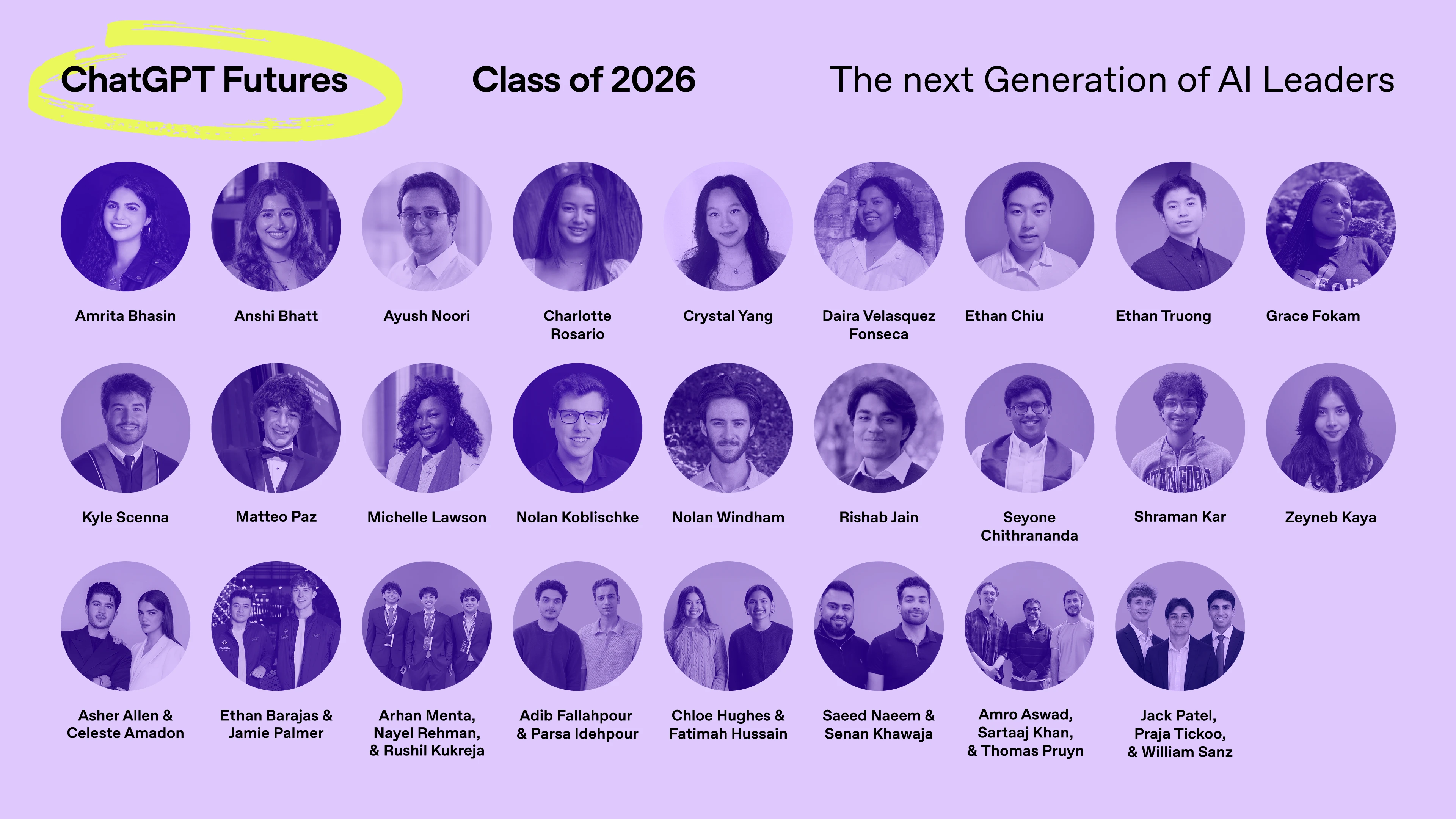
OpenAI announces ChatGPT Futures: Class of 2026, empowering 26 students with AI tools and mentorship for innovative projects.
OpenAI Unveils ChatGPT Futures Program for Student Innovators
OpenAI has announced the launch of the ChatGPT Futures: Class of 2026 on May 6, 2026. This initiative selects 26 undergraduate and graduate students from universities worldwide, empowering them to leverage ChatGPT for innovative AI projects in research, development, and societal impact. The program aims to nurture the next generation of AI leaders by providing exclusive access to advanced ChatGPT tools, mentorship, and resources. OpenAI Blog
Program Details
The ChatGPT Futures program highlights students whose projects demonstrate real-world AI applications across fields such as healthcare, education, climate solutions, and creative arts. Participants come from prestigious institutions like Stanford, MIT, Oxford, and Tsinghua University. Their projects include AI-driven diagnostic tools for underserved communities and generative models for sustainable urban planning. OpenAI emphasizes that these students are "redefining learning, creativity, and opportunity" by integrating ChatGPT into their workflows. OpenAI Blog
Key features of the program include:
- Unlimited access to ChatGPT Plus and Pro tiers, including the new GPT-5.5 Instant model.
- Virtual mentorship sessions with OpenAI researchers.
- Opportunities to showcase work at AI conferences and collaborate on open-source initiatives.
- A dedicated online hub for sharing progress and fostering a global student AI community.
Participant Highlights
One notable participant, a biomedical engineering student from Cornell, is developing an AI agent for oral exam defenses to address concerns about ChatGPT cheating in academia. OpenAI Blog
Historical Context
This initiative builds on OpenAI's previous efforts like the ChatGPT Edu rollout in 2025, which included a $17 million contract with California State University for campus-wide access. Despite its success, the program faced criticism over ethical integration and data privacy concerns. Local News Matters
Competitor Comparison
OpenAI's move intensifies competition in AI education outreach:
- Google's Gemini Education Fund supports 50 students with Gemini 3.1 access, focusing on multimodal learning.
- Anthropic's Claude Scholars prioritizes safety-aligned AI research with 20 participants.
- Microsoft's Copilot for Education offers institutional licensing but lacks consumer-facing innovation.
| Feature | OpenAI ChatGPT Futures | Google Gemini Fund | Anthropic Claude Scholars |
|---|---|---|---|
| Cohort Size | 26 | 50 | 20 |
| Model Access | GPT-5.5 Instant + Images 2.0 | Gemini 3.1 | Claude 4.0 |
| Mentorship | OpenAI researchers | Google AI labs | Anthropic safety experts |
| Focus | Broad impact projects | Multimodal education | Safety research |
Strategic Timing
The announcement coincides with GPT-5.5's rollout, which enhances response accuracy and web search integration. This positions OpenAI to capture student loyalty amid ongoing debates over AI ethics in education. MacRumors
Broader Implications
Critics question the program's exclusivity, highlighting the need for broader access. Success could normalize AI in curricula, expanding OpenAI's user base, while failure might amplify biases or job displacement fears. Initiatives like this bridge the gap between academia and industry, though equity remains a key concern. Fortune
[[Internal Link: ChatGPT]]


