
OpenAI Faces Leadership Exodus Amid Data Center Strategy Shift
OpenAI's Stargate project faces leadership exits amid a strategic shift to cloud-based infrastructure, impacting its AI development plans.
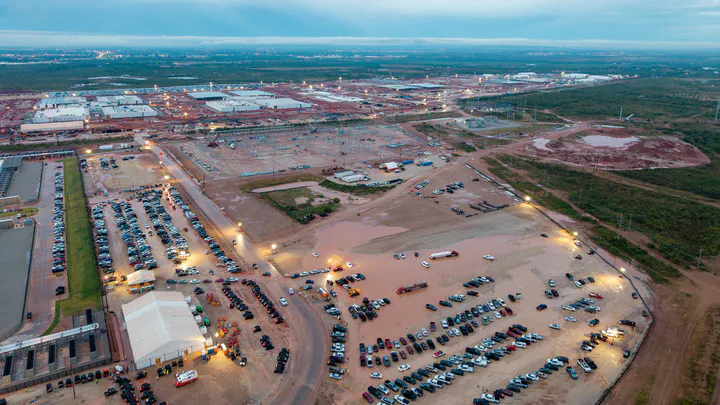
OpenAI Faces Leadership Exodus Amid Data Center Strategy Shift
Three key leaders of OpenAI's ambitious Stargate data center initiative—Peter Hoeschele, Shamez Hemani, and Anuj Saharan—have departed or are imminently leaving the company, signaling a major shakeup in the AI giant's infrastructure plans as reported by The Information on April 9, 2026.
This departure comes at a critical juncture for OpenAI, which has pivoted from constructing its own massive data centers under the Stargate banner to renting compute capacity from cloud providers. This shift underscores mounting pressures in the hyperscale AI infrastructure race. Hoeschele, who led Stargate efforts, exited immediately, while Hemani and Saharan are slated to follow in the coming days, according to sources familiar with the matter.
What is Stargate and Why the Leadership Vacuum?
Announced internally as OpenAI's crown-jewel infrastructure project, Stargate was envisioned as a $100 billion-plus supercomputer initiative capable of powering next-generation AI models far beyond current capabilities like GPT-4o and o1. The project aimed to build custom data centers with millions of GPUs to achieve unprecedented training scale, positioning OpenAI at the forefront of the AI arms race (The Information).
The trio's exits mark the latest turbulence in OpenAI's executive ranks. Hoeschele, a veteran in data center operations, spearheaded early planning; Hemani focused on engineering execution; and Saharan handled supply chain logistics. Their combined departure strips Stargate of its foundational team, raising questions about continuity.
No official statement from OpenAI has confirmed replacements, but the company has quietly reoriented toward partnerships with Microsoft Azure and Oracle for compute needs, abandoning in-house builds due to escalating costs and timelines (The Information).
Past Performance: Stargate's Rocky Track Record
Stargate's origins trace to mid-2024, when OpenAI and Microsoft first floated the idea amid booming demand for AI training compute. Initial plans targeted a 2028 operational date, but progress stalled. By late 2025, OpenAI faced GPU shortages and ballooning expenses, with reports of only partial prototype success in smaller-scale tests.
Historically, OpenAI's infrastructure bets have mixed results. Its partnership with Microsoft delivered GPT-3 and GPT-4, but custom projects like the 2024 "supercluster" in Iowa underperformed on efficiency, consuming power equivalent to small cities while yielding incremental gains. Stargate amplified these issues: supply chain delays from NVIDIA's chip monopoly pushed costs 30-50% over projections, per industry analysts tracking similar hyperscalers.
Competitor Comparison: OpenAI Lags in the Infrastructure Sprint
OpenAI's pivot contrasts sharply with rivals aggressively building their own empires:
| Company | Key Initiative | Status | Compute Scale | Edge Over OpenAI |
|---|---|---|---|---|
| xAI (Elon Musk) | Colossus Cluster | Live since 2025; 100k+ H100 GPUs expanding to 1M | In-house Texas data centers | Vertical integration with Tesla Dojo; lower latency |
| Google DeepMind | TPU v6 Pods | Deployed 2026; quantum-hybrid | 10M+ equivalent FLOPs | Custom silicon beats NVIDIA on efficiency by 4x |
| Anthropic | AWS Trainium Clusters | Scaling via Amazon; $4B funding | 500k+ GPUs committed | Cost-sharing model avoids OpenAI's capex burdens |
| Meta AI | Llama 4 Superclusters | Internal; open-source edge | Millions of GPUs across US/EU | No rental dependency; faster iteration cycles |
OpenAI trails due to its rental-heavy model, which incurs 20-40% premiums versus owned assets, per Refinitiv data.
Why Now? Strategic Context and Market Pressures
The timing aligns with OpenAI's post-Sam Altman board crisis recovery and a 2026 AI compute crunch. NVIDIA's Blackwell delays and US export curbs to China have throttled supply, forcing hyperscalers to ration chips. Energy demands for Stargate—projected at 5GW, rivaling nuclear plants—clashed with regulatory hurdles in potential sites like Texas and Arizona.
Investor impatience plays a role: SoftBank's $40B commitment for Stargate faltered amid ROI doubts, prompting a leaner strategy. Broader market dynamics, including falling AI hype stocks and rising power costs (up 15% YoY), make custom builds untenable.
Skeptical voices abound. Tech analysts question if the pivot signals deeper mismanagement: "OpenAI's Stargate was vaporware from day one—renting is admission of defeat," noted a former executive in The Information's coverage. Critics like xAI's Musk have mocked it on X as "overhyped fantasy," highlighting OpenAI's 18-month delay versus Colossus.
Implications for OpenAI and the AI Landscape
This shakeup could accelerate OpenAI's reliance on Microsoft, deepening lock-in but easing short-term bottlenecks for models like GPT-5. Long-term, it risks ceding ground to vertically integrated players, potentially hiking costs 25% by 2028.
OpenAI's talent drain—now totaling 12 senior exits in 2026—tests its resilience amid $7B+ annual losses. Success hinges on swift rehiring and partnership execution, lest competitors solidify dominance in the compute wars.


