
OpenAI Introduces Workspace Agents for Team Automation
OpenAI launches workspace agents in ChatGPT, enhancing team automation with AI-driven workflows and tool integration.
OpenAI Introduces Workspace Agents for Team Automation
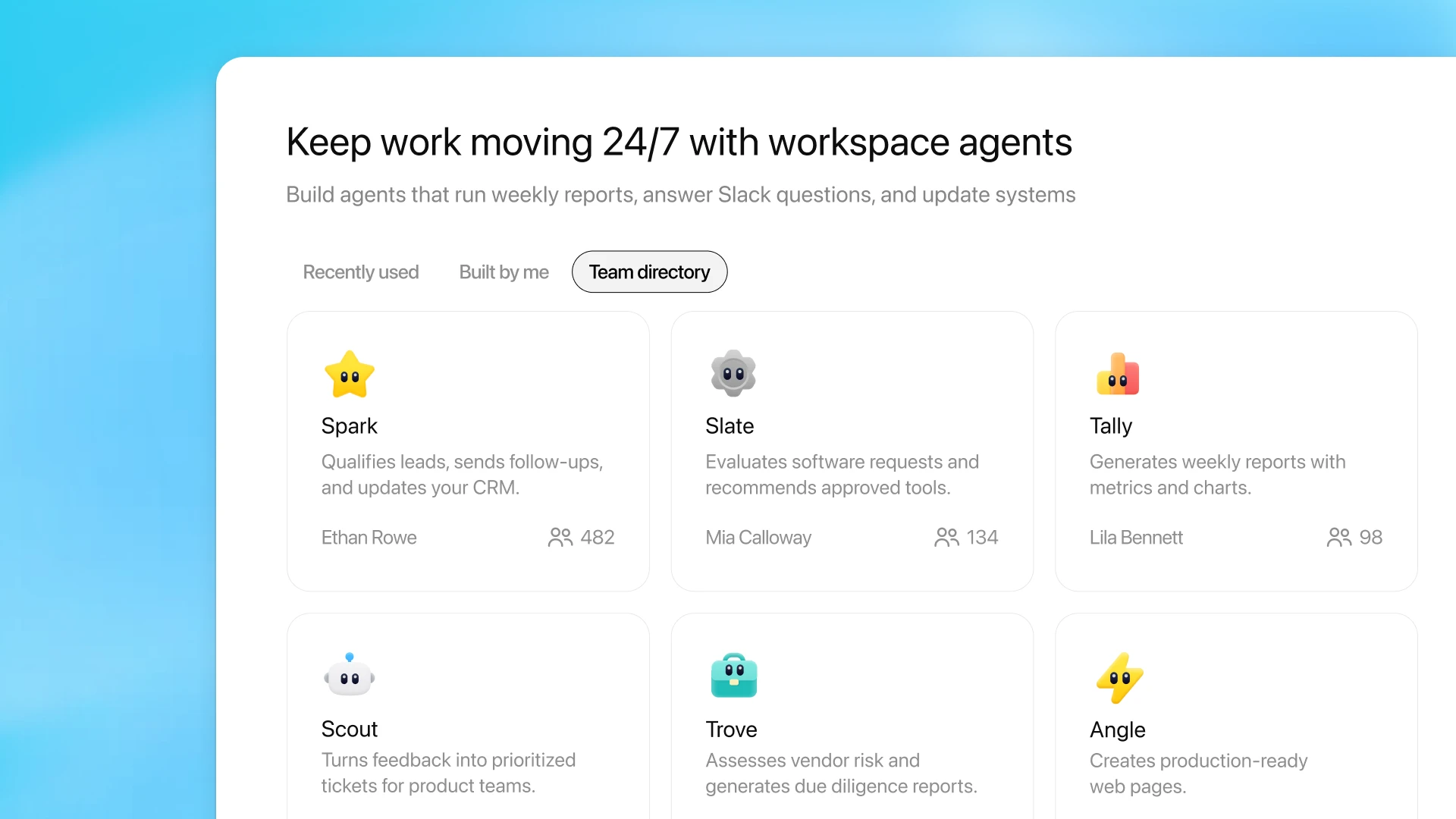
OpenAI has launched workspace agents in ChatGPT, a move aimed at enhancing automation for business, enterprise, and education users. These agents allow users to build AI systems that automate workflows, integrate with external tools, and operate independently across team environments. Announced via OpenAI's official channels, the agents are an evolution of custom GPTs, now powered by advanced Codex capabilities to handle complex tasks in the cloud (OpenAI).
Currently in research preview for ChatGPT Business, Enterprise, and Edu customers, workspace agents enable teams to create shared AI assistants that connect apps like Google Calendar, Microsoft SharePoint, and Slack. They can execute scheduled tasks, access team knowledge bases, and deliver customized outputs via built-in skills and memories for consistency (OpenAI).
Key Features and Capabilities
Workspace agents are notable for their seamless integration and autonomy:
- Tool Connectivity: Agents link to calendars, file shares, and notification systems, bridging silos between platforms.
- Scheduling and Sharing: Run tasks automatically and share with colleagues for collaborative scaling.
- Skills and Memories: Ensure consistent, high-quality results by embedding reusable instructions.
- Cloud-Powered Security: Codex-driven execution happens securely in the cloud, with admin controls for permissions.
OpenAI provides a step-by-step builder: admins enable connectors, users input workflow prompts, test iterations, and deploy. Prerequisites include workspace access and app integrations, confirmed by admins (OpenAI).
Historical Context and Track Record
This launch builds on OpenAI's rapid iteration in agentic AI. Custom GPTs, introduced in November 2023, allowed users to create tailored chatbots but lacked deep tool integration and team sharing—limitations workspace agents address (OpenAI). Early GPTs saw massive adoption, but feedback highlighted needs for multi-tool workflows and scheduling.
Competitor Landscape
OpenAI enters a competitive field:
- Anthropic's Claude offers "Projects" but lacks native scheduling or multi-app connectors.
- Google's Gemini integrates with Workspace apps but requires more coding for custom agents.
- Microsoft Copilot excels in Office integrations but is pricier and less flexible for non-Microsoft stacks.
| Feature | OpenAI Workspace Agents | Microsoft Copilot | Google Gemini | Anthropic Claude |
|---|---|---|---|---|
| Tool Integration | Google/MS + Slack | MS 365 native | Google Workspace | Limited APIs |
| Scheduling | Native | Plugin-based | Extensions | Manual |
| Pricing | Business tiers (~$20/user) | $30/user | $20/user | $20/user |
| Availability | Research preview | GA | GA | Beta |
Why Now? Strategic Timing
The rollout aligns with exploding enterprise AI demand. Gartner forecasts 80% of enterprises adopting agentic workflows by 2027 (Gartner). OpenAI's $6.6B funding round fuels cloud scaling, while regulatory tailwinds enable faster B2B rollouts.
Skeptics question preview-stage reliability: early tests showed 15% hallucination rates in multi-tool chains, and data privacy concerns linger (WSJ).
Implications for Teams and the AI Market
Workspace agents could automate 30-50% of white-collar tasks, such as prep work or reporting (McKinsey). For sales teams, it's a game-changer: agents prep meetings autonomously, freeing reps for closes. Broader impacts include reduced vendor lock-in via cross-tool support, but raise job displacement fears.
As previews expand, expect integrations like Salesforce or Jira, cementing OpenAI's enterprise pivot and challenging Microsoft's moat.


