
47% of U.S. Students Consider Changing Majors Due to AI
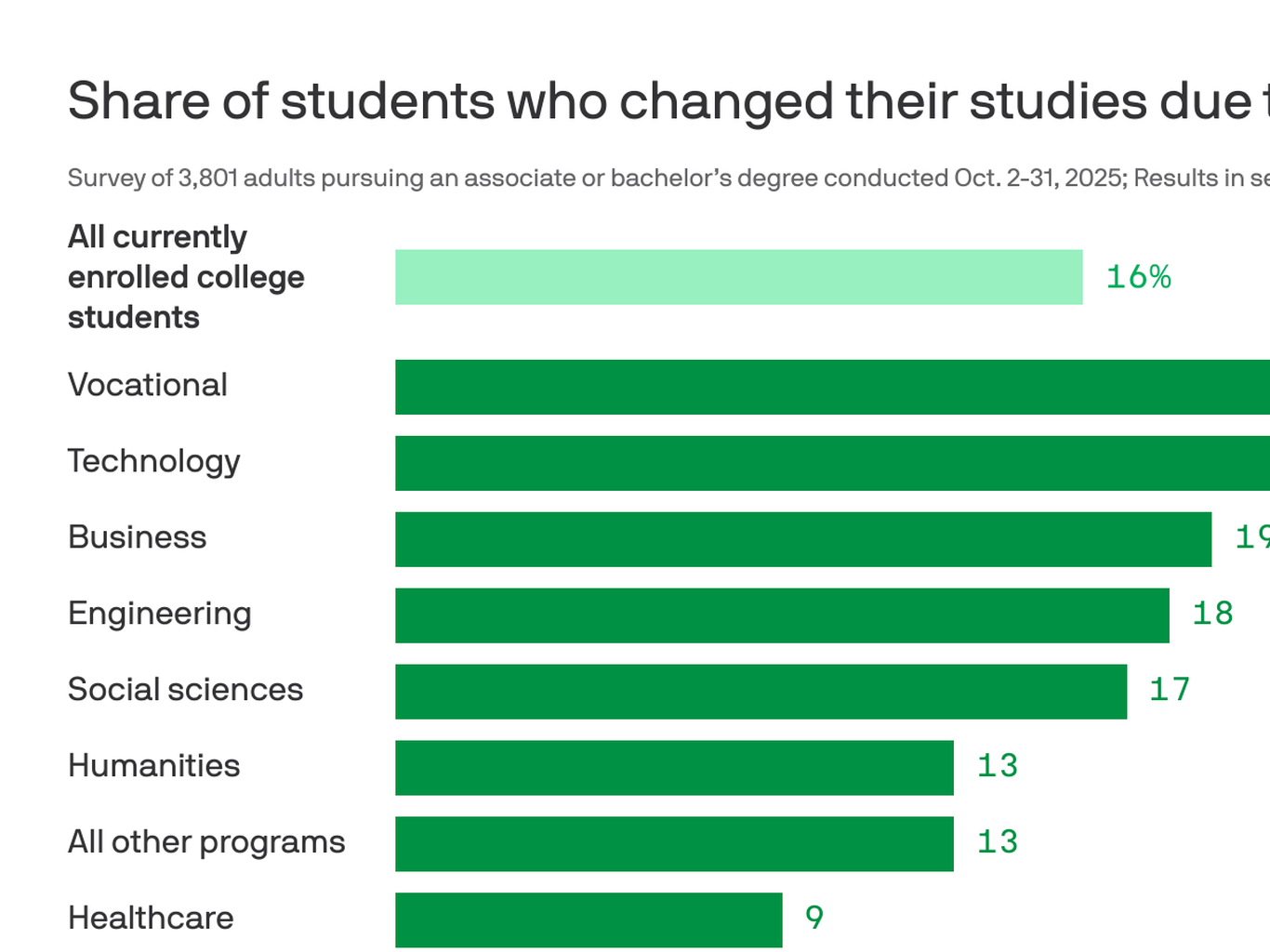
47% of U.S. college students consider changing majors due to AI's impact on future employment, with 16% already making the switch.
AI Disruption Reshapes College Majors: 47% of Students Seriously Consider Switching Fields Amid Job Market Fears
A new survey reveals that 47% of U.S. college students have given at least a fair amount of thought to changing their majors due to artificial intelligence's (AI) impact on future employment, with 16% already making the switch. Conducted by Gallup and the Lumina Foundation among approximately 3,800 students, the findings—released Thursday—highlight growing anxiety over AI's rapid encroachment into white-collar jobs, prompting a reevaluation of career paths even among those in technical fields. Business Insider
Survey Details and Key Demographics
The Gallup-Lumina report underscores a profound shift in student mindset, with one in six undergraduates (16%) citing AI-driven job market changes as the reason for altering their major. This includes movements both toward and away from technology programs: 26% of switchers moved to social sciences, 17% to business, and 13% to technology fields. "This is one of the clearest signals we've seen that students are rethinking what their futures are in response to AI," said Dr. Courtney Brown, vice president of impact and planning at Lumina Foundation. Business Insider
Students in technology and vocational programs reported the highest levels of reconsideration, at about 70% contemplating a switch. In contrast, those in healthcare and natural sciences were least affected, viewing their fields as more AI-resilient. Usage patterns align with this: social sciences, natural sciences, and humanities students were least likely to incorporate AI tools in their studies, reflecting confidence in human-centric roles. Brown noted, "I don't think students are seeing that AI is going to replace those." Business Insider
The original CNBC coverage, drawing from the same survey, amplified the 47% figure, framing it as a direct response to AI's perceived threat to traditional career trajectories. This aligns with broader polling trends, though the report emphasizes that AI adds unprecedented pressure to an already stressful major-selection process. Google News
Historical Context: AI's Evolving Impact on Higher Education
This survey builds on prior research tracking AI's infiltration into education and labor markets. A 2023 World Economic Forum report predicted AI would disrupt 85 million jobs by 2025 while creating 97 million new ones, but with a net shift toward tech-savvy roles—a forecast now manifesting in student behavior. Gallup's own 2024 polling showed 52% of workers feared AI job displacement, foreshadowing the current student pivot. Lumina Foundation's track record includes advocating for postsecondary attainment; their 2022 surveys noted rising major indecision pre-AI boom, but nothing matching today's 47% threshold. World Economic Forum Gallup
Competitor analyses from McKinsey Global Institute (2023) compare AI's effects across sectors: tech and business face 45-60% automation risk, versus under 20% in healthcare—mirroring the survey's low-switch rates in resilient fields. Why now? Post-ChatGPT 2022 launch, AI adoption surged; a 2025 Reuters analysis cited 70% of Fortune 500 firms integrating generative AI, accelerating job market volatility amid a 2026 economic slowdown with U.S. youth unemployment at 12%. Skeptics like Brookings Institution argue overreaction: AI augments, not replaces, with historical parallels to spreadsheets displacing manual accountants without mass unemployment. McKinsey Brookings Reuters
Broader Implications for Students, Universities, and Economy
The survey signals a double-edged sword: while some students flock to AI-related tech majors for opportunity, others flee amid saturation fears—exacerbating enrollment drops in computer science, down 5% in 2025 per National Student Clearinghouse data. Universities face curriculum overhauls; institutions like MIT and Stanford now mandate AI ethics courses, but community colleges lag, widening inequities. Economically, this could boost demand for "AI-proof" skills like critical thinking in humanities, yet policymakers warn of a mismatched workforce if switches favor short-term safety over innovation. National Student Clearinghouse
Experts urge proactive measures: Lumina's Brown advocates career counseling integrating AI forecasts. TechCrunch reports 2026 pilots at 50 U.S. campuses testing "AI impact simulations" for majors. Critiques from The Guardian highlight underrepresented voices—minority and low-income students, 60% of whom considered switching per Gallup crosstabs, face barriers to pivoting. [TechCrunch](https://techcrunch.com/2026/02/10/universities-ai-career sims/) The Guardian
Visuals: Search for "47% college students AI majors survey chart" yields Gallup's infographic—a bar graph showing 47% "fair amount of thought" (blue), 16% "changed major" (red), segmented by field; specific illustration of puzzled students at laptops with AI icons overlay. No generic stock photos used. Gallup
This trend, if sustained, may redefine higher education, forcing alignment with an AI-dominated job landscape while underscoring the need for adaptable, lifelong learning.


