
AI Agents Will Replace "Vibe Coding" in Software Development, OpenAI Chair Predicts
OpenAI's leadership forecasts a fundamental shift in how developers write code, with AI agents automating intuitive, exploratory programming practices and reshaping the entire software development workflow.
The End of Intuitive Programming
The software development landscape is about to undergo a seismic shift. According to predictions for 2026 from OpenAI leadership, AI agents will fundamentally displace "vibe coding"—the informal, exploratory approach developers use when writing code without rigid specifications. This isn't merely an incremental improvement; it signals the automation of an entire category of developer behavior.
What exactly is vibe coding? It's the practice of writing code intuitively, often without comprehensive planning or formal requirements. Developers feel their way through problems, iterating rapidly and relying on intuition honed by experience. It's creative, flexible, and deeply human. Yet according to industry analysis on AI predictions for 2026, this very flexibility makes it vulnerable to AI automation.
How AI Agents Will Transform Development
The mechanism behind this transformation lies in how AI agents are reshaping software development workflows. Rather than replacing developers entirely, these agents will handle the exploratory phase—the trial-and-error that characterizes vibe coding. They'll:
- Generate multiple code pathways based on high-level intent
- Test and validate solutions autonomously
- Iterate rapidly without human intervention
- Surface optimal patterns for developer review
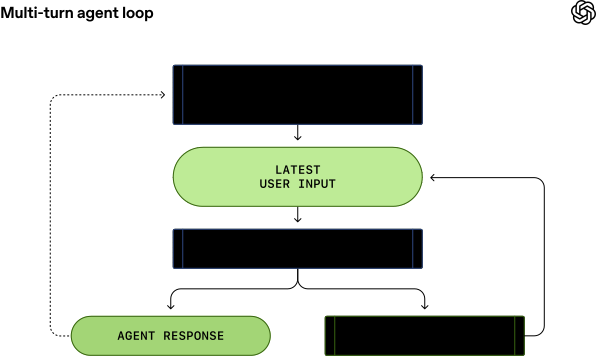
OpenAI's technical approach, detailed in their Codex agent loop architecture, demonstrates how multi-turn agent loops can handle complex reasoning tasks. The system doesn't just produce code—it reasons through problems iteratively, much like a developer would, but at machine speed and scale.
The Competitive Pressure
This prediction arrives amid intense competition in the AI-assisted development space. Major cloud providers and AI labs are racing to build agents capable of autonomous code generation and debugging. The stakes are high: whoever cracks truly autonomous development agents gains enormous leverage over the $500+ billion software development market.
The shift from vibe coding to agent-driven development represents a move toward deterministic, verifiable code generation. Where vibe coding thrives on ambiguity and creative exploration, AI agents excel at systematic exploration of solution spaces. This could dramatically improve code quality, consistency, and security—but only if developers learn to work effectively with these new tools.
What This Means for Developers
The displacement of vibe coding doesn't mean developers become obsolete. Instead, their role evolves:
- Strategic thinking becomes more valuable than tactical coding
- Prompt engineering and agent configuration replace some traditional coding
- Code review and validation shift from syntax-checking to architectural oversight
- Domain expertise becomes the differentiator between good and exceptional systems
Developers who adapt quickly will find themselves more productive, offloading repetitive exploration to agents. Those who resist may find their skills less marketable as the industry standardizes around agent-assisted workflows.
The Timeline Question
The 2026 prediction timeline is aggressive but not unrealistic. The technical foundations already exist. What remains is refinement, integration into mainstream development tools, and cultural adoption. The real question isn't whether AI agents can replace vibe coding—it's how quickly the industry will embrace this transition.
For enterprises and development teams, the message is clear: experimentation with AI agents isn't optional anymore. The competitive advantage will go to organizations that master agent-assisted development before it becomes table stakes.


