
DeepMind's Aletheia AI Cracks 13 Erdős Problems, Reshaping Mathematical Discovery
Google DeepMind's Aletheia AI has solved 13 longstanding mathematical problems attributed to Paul Erdős, marking a watershed moment in AI-driven mathematical research and challenging the boundaries between human and machine discovery.
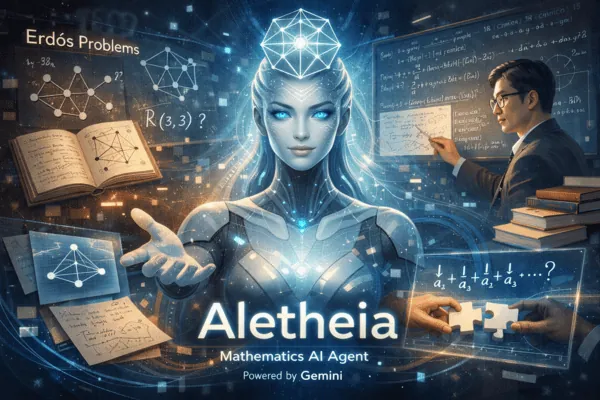
The Breakthrough That Changes Everything
The race to automate mathematical discovery just entered a new era. Google DeepMind's Aletheia AI has successfully solved 13 open problems attributed to the legendary mathematician Paul Erdős, problems that have resisted human effort for decades. This isn't a parlor trick or a narrow benchmark victory—it's evidence that AI systems can now operate as autonomous research agents, tackling problems at the frontier of human knowledge without explicit human guidance.
The implications ripple across academia and industry. If AI can crack problems that have stumped professional mathematicians, what does that mean for the future of mathematical research, peer review, and the very definition of discovery?
What Makes Aletheia Different
According to DeepMind's technical documentation, Aletheia represents a fundamental shift from competition-focused AI systems to fully autonomous research agents. The system doesn't just solve problems—it reasons through them, explores multiple solution pathways, and validates its own work.
Key capabilities include:
- Autonomous reasoning: The system can decompose complex mathematical problems into tractable sub-problems
- Multi-modal exploration: Aletheia combines symbolic reasoning with numerical methods
- Validation mechanisms: Built-in verification to ensure solutions meet rigorous mathematical standards
- Iterative refinement: The ability to backtrack and explore alternative approaches when initial paths prove unproductive
According to technical analysis from The Decoder, while Aletheia excels at well-defined mathematical problems, it remains prone to hallucination and error in less structured domains. This specificity is important: the system's success doesn't translate universally across all AI tasks.
The Erdős Connection: Why These Problems Matter
Paul Erdős, the prolific Hungarian mathematician, left behind a legacy of over 1,500 published papers and countless open conjectures. His problems span combinatorics, graph theory, and number theory—domains where elegant solutions often require deep structural insight rather than brute computational force.
The fact that Aletheia solved 13 of these problems signals that the system has developed genuine mathematical intuition, not merely pattern-matching capability. These aren't problems with known solutions waiting to be retrieved—they're problems where the solution pathway itself is the discovery.
What This Means for Research
The broader context matters here. AI systems have already demonstrated superiority in chess, Go, and protein folding. Mathematics was supposed to be different—a domain where human creativity and insight reign supreme. DeepMind's latest work suggests that assumption needs revision.
The research community now faces practical questions:
- How should mathematical journals handle AI-generated proofs?
- What constitutes "discovery" when machines can autonomously solve open problems?
- Will funding for mathematical research shift toward AI-augmented teams?
The Skepticism Worth Noting
It's important to acknowledge limitations. While Aletheia excels at formal mathematical problems, the system's broader reasoning capabilities remain inconsistent. Success in mathematics doesn't automatically translate to breakthroughs in physics, chemistry, or biology—domains where empirical validation and experimental design matter as much as theoretical reasoning.
Additionally, the problems Aletheia solved, while genuinely difficult, represent a specific class of mathematical challenge. Generalization to other research domains remains an open question.
The Inflection Point
What we're witnessing is the transition from AI as a tool to AI as an autonomous researcher. DeepMind's Aletheia marks a clear inflection point in this trajectory, demonstrating that machines can not only solve problems humans pose, but discover solutions to problems humans have failed to crack.
The mathematical community will spend years unpacking the implications. For now, one thing is certain: the age of AI-driven mathematical discovery has arrived.


