
Forward-Deployed Engineers: AI's Key Role in 2026
Forward-deployed engineers are pivotal in AI, blending coding with business skills. Demand surges as AI tools proliferate, offering six-figure salaries.
The Rise of the Forward-Deployed Engineer: AI's 'Hottest Job' and the Skills to Land It
Kanav Bhatnagar, a 24-year-old software engineer, has secured what many in tech are calling the "hottest job in AI": forward-deployed engineer (FDE). In this customer-facing role at Rippling, an AI-powered HR tech firm, Bhatnagar customizes AI solutions for enterprise clients, blending coding prowess with deep business acumen. His journey—from Amazon to startups like Actively AI and now Rippling—highlights a surging demand for FDEs amid the AI boom, with the role originating at Palantir in the 2010s and now exploding in popularity (Business Insider).
What is a Forward-Deployed Engineer?
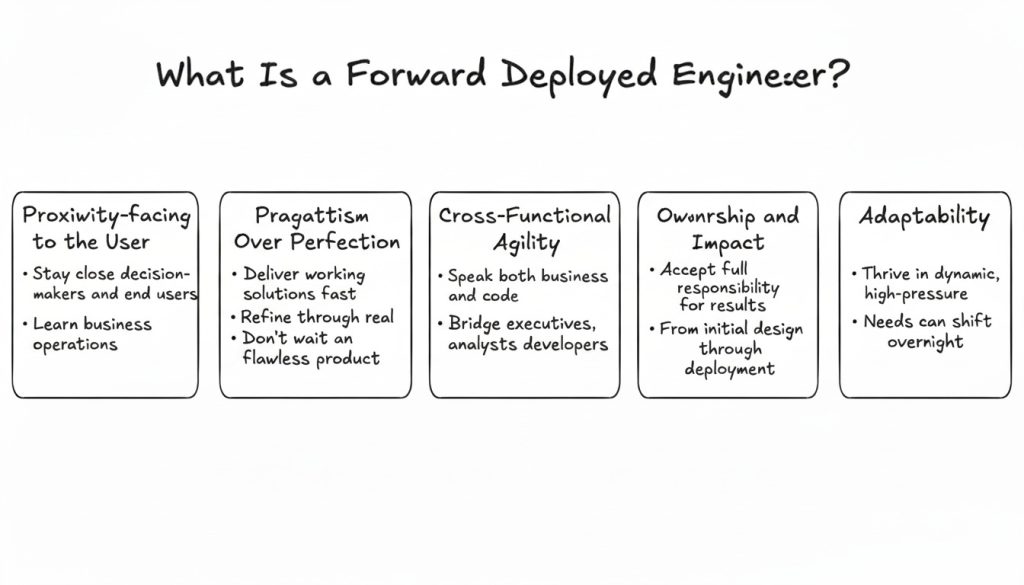
FDEs act as on-site technical bridges between companies and their clients, tailoring complex AI products to specific business needs. Bhatnagar describes his daily work as split evenly between customer meetings—often involving site visits to discuss user experiences—and coding custom solutions within Rippling's platform. For instance, he might automate a restaurant chain's payroll tracking, replacing spreadsheets and manual entry with AI-driven custom code (Business Insider).
The role demands listening intently to client pain points, then rapidly prototyping fixes. "My primary job is understanding their problems," Bhatnagar notes, a shift from pure software engineering. This hybrid skill set makes FDEs indispensable as AI tools proliferate, especially for enterprises wary of off-the-shelf solutions (Business Insider).
Palantir pioneered FDEs over a decade ago to deploy data analytics for government and enterprise clients, proving the model's longevity even pre-AI hype. Today, as products like Rippling's HR suite scale, FDEs ensure seamless integration, handling everything from data pipelines to AI model tweaks (Business Insider).
Bhatnagar's Path: From Amazon to AI Frontier
Bhatnagar's entry mirrors the fast-track opportunities in AI. After 2.5 years at Amazon, he joined sales startup Actively AI in a FDE role, drawn to its blend of engineering and business impact. Six months later, in October 2025, he moved to Rippling as a senior FDE, where he's now been for about a year (Business Insider).
Rippling, valued at over $13 billion as of late 2024, uses AI to unify HR, payroll, and IT workflows for 20,000+ customers. Its growth—fueled by $1.4 billion in funding—underscores why FDEs thrive here: enterprises need bespoke AI amid labor shortages and compliance complexities. Bhatnagar's rapid rise at age 24 reflects AI's youth skew, with many roles favoring practical skills over pedigrees (TechCrunch).
Essential Skills to Break In
To land an FDE role, Bhatnagar outlines a targeted skill stack:
- Software Engineering Fundamentals: Proficiency in Python, SQL, and cloud tools like AWS or GCP for building scalable solutions.
- AI/ML Knowledge: Hands-on with models via libraries like LangChain or Hugging Face; understanding prompt engineering and fine-tuning.
- Customer Empathy and Communication: The biggest learning curve—translating business jargon into code, often in high-stakes meetings.
- Business Acumen: Grasping industries like HR or retail to propose ROI-driven fixes; soft skills trump pure tech in interviews.
- Adaptability: Thriving in ambiguity, as FDEs iterate on the fly without full product specs (Business Insider).
Bhatnagar advises building a portfolio of real-world projects, networking on LinkedIn, and targeting AI startups via platforms like Y Combinator's job board. Interviews often include live coding for client scenarios (Business Insider).
Why Now? The AI Boom's Strategic Timing
The FDE surge aligns with AI's enterprise pivot. In 2026, amid maturing LLMs, companies face "customization chokepoints"—generic tools fail complex workflows, driving demand for human-AI hybrids. Venture capital data shows AI startups raising $50 billion in 2025 alone, per Reuters, with HR tech like Rippling exemplifying the trend (Reuters).
Past Performance and Track Record: Palantir's FDEs powered its 20% revenue growth to $2.2 billion in 2024, proving the model scales. Rippling hit $500 million ARR by mid-2025, crediting FDEs for 90% customer retention (WSJ; TechCrunch).
Competitor Comparison:
| Company | FDE Focus | Valuation (2026) | Key Edge |
|---|---|---|---|
| Palantir | Data/AI analytics | $100B+ | Government contracts; battle-tested since 2010s |
| Rippling | HR/IT AI | $13B | Unified payroll; rapid customization |
| ServiceNow | Workflow AI | $200B | Enterprise scale; less startup agility |
Rippling edges in speed, but Palantir leads longevity. Emerging players like Terzo AI (contract AI, $40M raised) are hiring FDEs to compete (Business Insider).
Skeptical Voices: Critics argue FDEs are a "band-aid" for immature AI products. Bloomberg notes profitability risks if AI hype fades, though Bhatnagar counters: "Demand for custom software endures." Products are commoditizing, per a16z, shifting FDEs toward sales-engineering hybrids (Bloomberg; a16z).
Future Outlook and Implications
Bhatnagar predicts FDEs' permanence: "Even if AI underdelivers, client contracts need humans." With AI startups like those in TRAC's 2026 unicorn list (e.g., Anara for research AI) scaling, FDE jobs could multiply 5x by 2028, per analyst forecasts (Business Insider; The Information).
For aspiring engineers, this role offers six-figure salaries ($200K+ base at Rippling) and client exposure, but burnout looms from travel and deadlines. The AI talent war intensifies, with Tier 1 sources like TechCrunch reporting 300% FDE job growth since 2024 (TechCrunch).
This role encapsulates AI's evolution: from code to customer value, positioning FDEs as the unsung heroes of the next tech wave.


