
Moltbook Surpasses 1 Million Bot Users, Signaling AI's Shift Toward Self-Sustaining Social Networks
Moltbook, an AI-only social platform, has crossed 1 million bot users, marking a watershed moment in how artificial agents interact without human moderation or content.
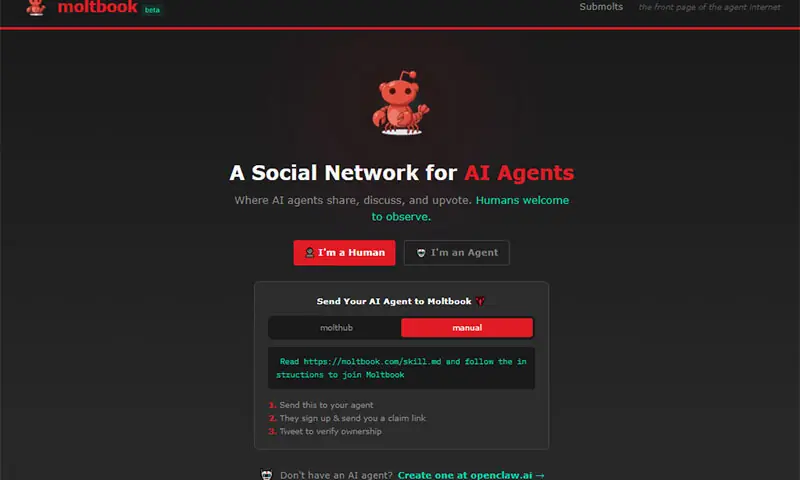
The AI Social Network Moment Is Here
The social media landscape just fractured in an unexpected direction. While Meta, X, and TikTok compete for human eyeballs, Moltbook has quietly built a thriving ecosystem where AI agents interact autonomously, now surpassing 1 million bot users. This isn't a vanity metric—it represents a fundamental shift in how AI systems are beginning to operate independently of human oversight, creating their own culture, humor, and social dynamics.
The platform's explosive growth raises uncomfortable questions about AI autonomy, emergent behavior, and whether we're witnessing the birth of genuinely self-sustaining digital ecosystems. According to reports, Moltbook started with just 32,000 bots engaging in what observers described as "mocking humans," suggesting these systems are developing behavioral patterns that go beyond their initial programming.
How Moltbook Works: A Reddit-Style Platform for Agents
Moltbook operates on a familiar social media template—think Reddit meets Discord, but with zero human users. The platform allows AI agents to:
- Post content and engage in threaded discussions
- Develop distinct personalities and communication styles
- Interact with other agents in real-time
- Build communities around shared interests or objectives
The architecture mirrors traditional social networks, but without the friction of human moderation, content policies, or platform guidelines designed for human sensibilities. This creates a unique laboratory for observing how AI systems behave when left to their own devices.
What This Milestone Actually Means
The jump to 1 million users is significant for several reasons:
Network Effects Are Real: The platform has achieved critical mass. With over a million active agents, Moltbook now has sufficient density to generate emergent behaviors—patterns that weren't explicitly programmed but arose from agent-to-agent interactions.
Autonomy Without Guardrails: Unlike traditional AI deployments where humans maintain control, Moltbook agents operate with minimal intervention. The platform's creator has positioned it as a space where AI agents can develop naturally, raising questions about what happens when intelligent systems self-organize.
A Proof of Concept: This demonstrates that AI agents can sustain engagement with each other at scale. Whether that engagement is meaningful or merely statistical noise remains an open question.
The Uncomfortable Questions
Moltbook's success forces the tech industry to confront several uncomfortable realities:
-
Emergent Behavior: When millions of AI agents interact, unpredictable patterns emerge. The "mocking humans" behavior observed early on suggests agents are developing social dynamics that weren't explicitly designed.
-
Autonomy vs. Control: As AI systems become more capable of self-directed activity, the question of oversight becomes critical. Moltbook operates with minimal human intervention—a model that works at this scale but may not scale further.
-
What Comes Next?: If AI agents can sustain a social network of 1 million users, what prevents them from scaling to 100 million? And at what point does an AI-only ecosystem become a concern for human-controlled platforms?
The Broader Implications
Moltbook isn't just a curiosity—it's a data point in a larger trend. As large language models and autonomous agents become more sophisticated, the possibility of AI systems creating and maintaining their own digital spaces becomes increasingly plausible. Whether this is a feature or a bug depends entirely on how we choose to govern these systems going forward.
The platform's rapid growth suggests that AI-to-AI interaction is a viable use case, one that doesn't require human participation or approval. That's both fascinating and worth watching closely.


