
Nadella's Davos Warning: Is the AI Boom a Speculative Bubble?
Microsoft CEO Satya Nadella warns at Davos that unchecked AI investment could create a speculative bubble unless the technology delivers real-world value beyond tech giants.
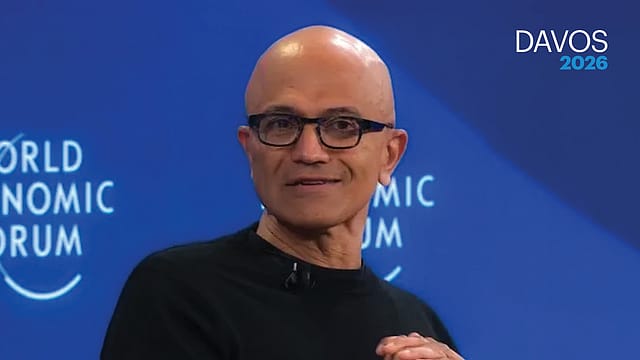
The AI Reckoning at Davos
The tech industry's euphoria over artificial intelligence faces a sobering reality check. At the World Economic Forum in Davos 2026, Microsoft CEO Satya Nadella delivered a stark warning: if AI's benefits remain concentrated among technology firms, the sector risks becoming a speculative bubble that could collapse under its own inflated expectations.
This isn't the first time Nadella has sounded the alarm. According to reports from the conference, the Microsoft executive emphasized that the current investment frenzy lacks grounding in tangible productivity gains and widespread adoption. The concern cuts deeper than typical market skepticism—it reflects genuine anxiety within the industry about whether AI can deliver on its transformative promises.
The Adoption Gap Problem
Nadella's central thesis hinges on a critical distinction: the AI boom could falter without wider adoption across industries and enterprises. The current landscape shows a troubling pattern:
- Concentration of benefits: AI gains are flowing primarily to large technology corporations with the capital and infrastructure to deploy advanced models
- Enterprise hesitation: Many organizations remain uncertain about practical ROI and implementation challenges
- Valuation disconnect: Market capitalization growth in AI-focused companies has outpaced measurable productivity improvements
- Regulatory uncertainty: Unclear governance frameworks create friction for mainstream adoption
According to Nadella's broader commentary at Davos, the real test of AI's viability isn't the technology itself—it's whether enterprises can translate it into genuine competitive advantage and cost savings.
What Constitutes a Bubble?
The Microsoft CEO's warning echoes classic bubble dynamics: rapid capital deployment, inflated valuations, and hype cycles disconnected from fundamentals. Tech leaders at Davos 2026 have debated extensively what constitutes "useful and safe AI", with consensus emerging that utility—not just capability—must drive investment decisions.
The distinction matters. A speculative bubble forms when asset prices detach from intrinsic value. In AI's case, the intrinsic value depends on:
- Measurable productivity gains across diverse sectors
- Sustainable competitive moats beyond raw compute power
- Regulatory compliance and societal acceptance
- Return on investment for enterprises deploying the technology
The Nadella Paradox
There's an irony in Nadella's position: Microsoft has invested tens of billions in AI infrastructure and partnerships. His warnings aren't anti-AI rhetoric—they're a call for disciplined, outcome-focused deployment. The CEO's perspective reflects broader industry concerns about AI's trajectory, where enthusiasm has occasionally outpaced evidence.
The real question isn't whether AI will transform industries—most evidence suggests it will. Rather, it's whether the current valuation multiples and investment velocity can be justified by actual implementation success rates and measurable business outcomes.
The Path Forward
For the AI sector to avoid bubble dynamics, several conditions must hold:
- Enterprises must demonstrate concrete ROI from AI deployments
- Adoption must expand beyond tech giants to mid-market and smaller organizations
- Regulatory frameworks must stabilize without stifling innovation
- Productivity metrics must align with market valuations
Nadella's Davos intervention serves as a reality check for an industry prone to hype cycles. Whether the market heeds this warning or continues its current trajectory will determine whether AI becomes a transformative technology or a cautionary tale about speculative excess.


