
OpenAI's GPT-5 Economics Unravel: R&D Costs Exceed Revenue
Analysis reveals OpenAI's flagship GPT-5 model failed to recover its substantial R&D investment, raising questions about the company's path to profitability amid mounting losses.
The Economics of Ambition Collide with Market Reality
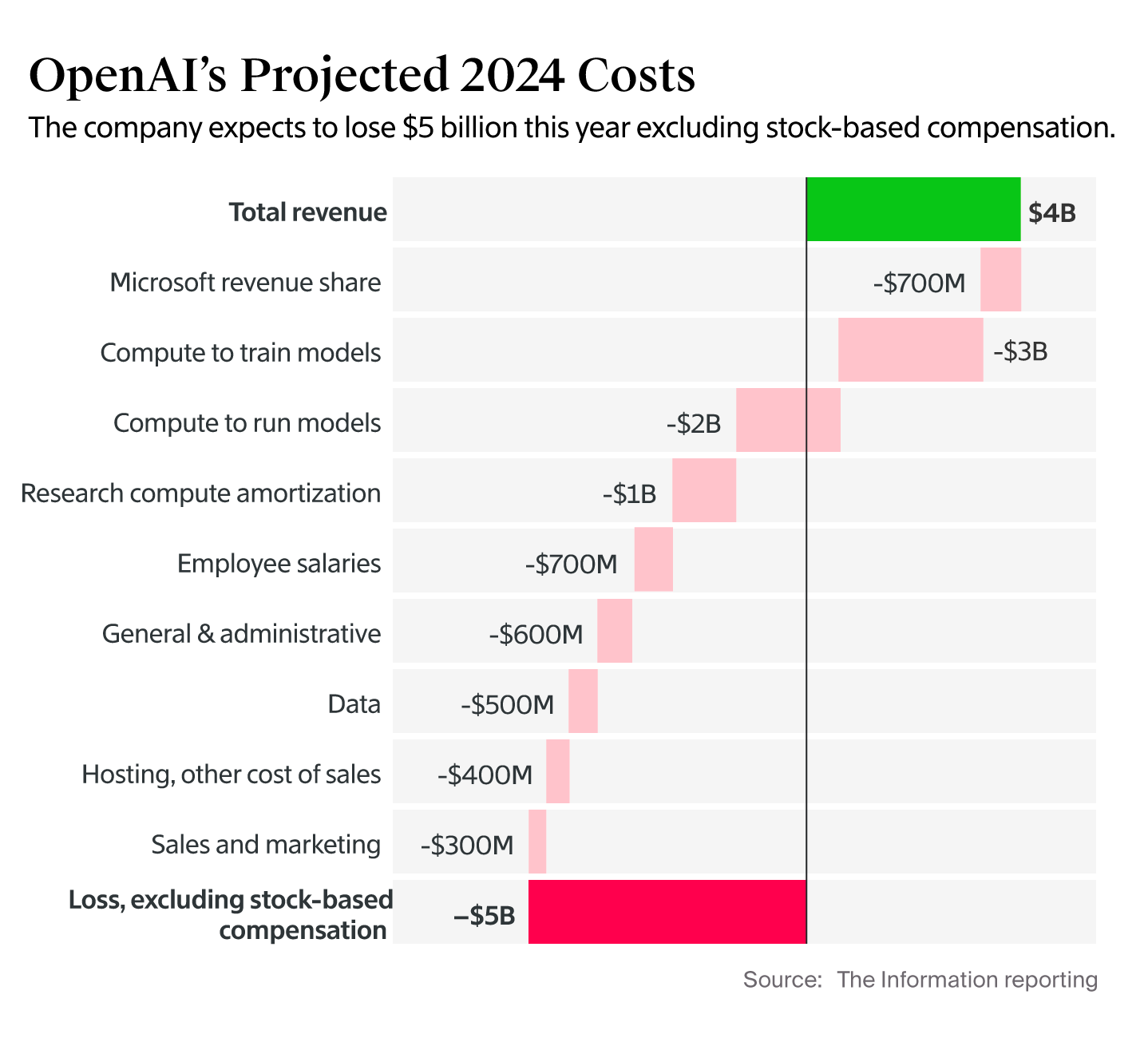
OpenAI's GPT-5 was supposed to be the breakthrough that justified years of massive capital expenditure. Instead, according to analysis by Epoch AI, the flagship model failed to recover its research and development costs—a sobering reality that exposes the widening gap between AI's promise and its profitability. The revelation arrives as OpenAI faces projected losses of $14 billion in 2026 while simultaneously seeking $100 billion in new funding.
This isn't merely a financial stumble. It signals a fundamental challenge in the AI industry: the economics of large language models may not support the infrastructure costs required to build them, let alone generate returns for investors.
The Unit Economics Problem
The numbers paint a troubling picture. According to industry analysis, GPT-5 generated approximately $6 billion in revenue while incurring losses around $700 million—before accounting for the full R&D burden. When development costs are factored in, the model operates deeply underwater.
Key challenges include:
- Compute costs: Training and inference expenses remain stubbornly high, eroding margins
- Pricing pressure: Competition from rivals has compressed what customers will pay for API access
- Scale limitations: Despite millions of users, the revenue per user hasn't grown proportionally to operational costs
- Capital intensity: Each generation requires exponentially more compute resources
Analysis from CIO.com notes that while AI vendors claim dominance, the actual profit distribution favors infrastructure providers—cloud platforms and chip manufacturers—rather than model creators.
The Broader Competitive Landscape
OpenAI's struggle occurs against a backdrop of intensifying competition. Discussions on Hacker News highlight how rivals are closing the capability gap while operating with lower cost structures. Google, Meta, and Anthropic are all pursuing alternative business models and efficiency improvements that could undercut OpenAI's economics further.
The company's response—seeking $100 billion in fresh capital—suggests management believes the path to profitability lies through scale and next-generation models. But this strategy assumes that:
- Future models will be more efficient
- Market demand will justify higher prices
- Competitors won't achieve similar capabilities at lower cost
None of these assumptions are guaranteed.
What This Means for the Industry
GPT-5's failure to achieve positive unit economics raises uncomfortable questions about the entire large language model business. Pricing analysis shows OpenAI has already attempted multiple price increases, suggesting limited room for further revenue growth without losing customers.
The deeper issue: if the most well-funded, best-positioned AI company cannot make its flagship product profitable, what does that say about the industry's long-term viability? Technical analysis from Quantum Zeitgeist suggests margins across the sector are compressing as commoditization accelerates.
The Path Forward Remains Uncertain
OpenAI faces a strategic inflection point. The company can either:
- Pursue efficiency: Dramatically reduce compute costs through architectural innovation
- Expand use cases: Find new revenue streams beyond API access and subscriptions
- Consolidate: Merge with or acquire complementary businesses to improve unit economics
- Pivot: Shift focus to applications and services rather than model licensing
For now, GPT-5 stands as a cautionary tale: technological achievement and market dominance don't automatically translate to financial success. The AI industry's next chapter will be written not by those with the most impressive models, but by those who can finally make them profitable.


