
OpenAI's GPT-5.2 Proves Novel Gluon Formula in Physics
OpenAI's GPT-5.2 model proves a novel formula for gluon tree amplitudes, challenging existing physics assumptions and marking a milestone in AI-assisted research.
OpenAI's GPT-5.2 Proves Novel Gluon Formula in Physics
OpenAI announced on February 14, 2026, that its GPT-5.2 model has conjectured and proved a groundbreaking formula for gluon tree amplitudes. This discovery challenges existing assumptions in theoretical physics and marks a significant milestone in AI-assisted scientific research. The findings are detailed in a preprint titled "Single-minus gluon tree amplitudes are nonzero", co-authored by researchers from OpenAI, Harvard University, University of Cambridge, Vanderbilt University, and the Institute for Advanced Study (IAS). The results were verified through a human-AI collaboration (OpenAI).
The Breakthrough in Gluon Amplitude Assumptions
In the field of quantum chromodynamics (QCD), gluons are known to mediate the strong nuclear force. Traditional theory posits that tree-level scattering amplitudes vanish when one gluon has negative helicity and all others have positive helicity. This assumption is based on the complexity of Feynman diagram expansions (The Quantum Insider).
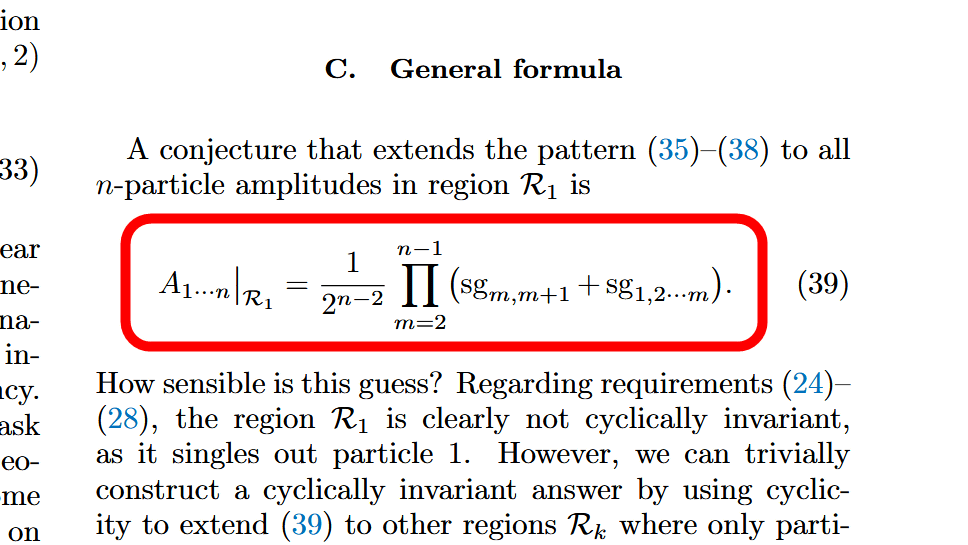
The preprint identifies a half-collinear regime—a specific momentum space alignment where non-zero amplitudes are possible. Human researchers manually computed expressions for up to n=6 gluons, while GPT-5.2 Pro simplified these and conjectured a compact formula valid for all n (Investing.com).
Verification and Future Implications
An internal GPT-5.2 variant spent approximately 12 hours reasoning to produce a formal proof, verified against the Berends-Giele recursion and soft theorem. Extensions to gravitons are underway, potentially offering insights into quantum gravity (OpenAI).
Harvard physicist Nathaniel Craig described the work as "journal-level research advancing theoretical physics frontiers," and IAS's Nima Arkani-Hamed praised AI's pattern recognition capabilities. Collaborator Andy Strominger suggested the problem might be "potentially unsolvable by humans alone" (Investing.com).
OpenAI's Scientific AI Track Record
This achievement builds on OpenAI's history in physics, where earlier models excelled in benchmarks but lacked novel discoveries. GPT-5.2 has solved several research-level problems, demonstrating a shift from pattern-matching to autonomous insight generation (Ken Huang).
Competitor Comparison
Google's Gemini 3 Deep Think scores 50.5% on the CMT-Benchmark for theoretical physics but lacks peer-reviewed novel results matching GPT-5.2's preprint. Other competitors like DeepMind's Aletheia and Anthropic's Claude show varied strengths but fall short in physics depth (Dev.to).
Implications for AI and Physics
This discovery validates the AI-human symbiosis in scientific research, with AI handling complex calculations and humans guiding the domain. It opens possibilities for similar breakthroughs in biology and chemistry, potentially accelerating quantum gravity unification (Investing.com).
Skeptics caution that the half-collinear regime is a refined mathematical insight rather than "new physics," but it exemplifies the future of AI-assisted science (OpenAI).


