
OpenClaw Hardens Defenses Against Government-Flagged Vulnerabilities
OpenClaw rolls out critical security patches following official warnings about exploitation risks in agentic AI systems. The update addresses vulnerabilities that could expose enterprise networks to unauthorized access and data breaches.
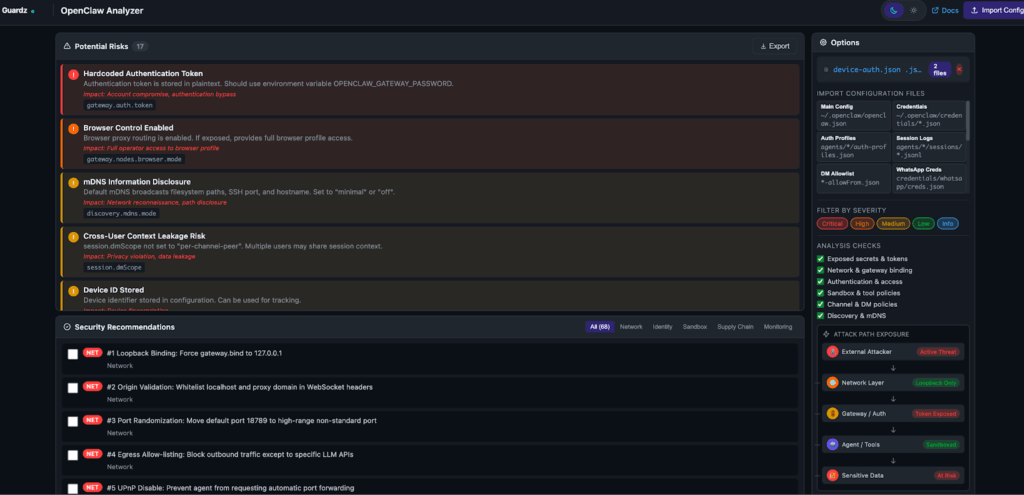
The Vulnerability Reckoning for AI Agents
The autonomous AI agent space just hit a sobering reality check. As government agencies and security researchers sound alarms about the exploitation risks embedded in systems like OpenClaw, the platform has released a security update aimed at plugging critical gaps. But the timing raises hard questions: How widespread are these vulnerabilities, and can patches alone address the fundamental architectural risks that security experts have been flagging?
OpenClaw, according to Cisco researchers, represents a new class of security nightmare—personal AI agents capable of autonomous action across enterprise systems. The latest update comes as Bitdefender's technical advisory details how threat actors could weaponize the platform's capabilities to infiltrate corporate networks.
What the Update Addresses
The security patch focuses on several critical areas:
- Enhanced scanning integration: OpenClaw now integrates VirusTotal scanning to detect malicious payloads before execution
- Authentication hardening: Strengthened credential handling to prevent unauthorized agent activation
- Sandboxing improvements: Better isolation of agent operations to limit lateral movement in compromised environments
- Audit logging: Expanded visibility into agent actions for forensic analysis
TrueSec's analysis underscores that while these measures are necessary, they represent defensive patches rather than architectural redesigns. The fundamental risk—that autonomous agents can be manipulated to execute unintended commands—persists.
The Broader Context
Government warnings about OpenClaw and similar agentic systems reflect a growing consensus: the current generation of autonomous AI tools was built for capability, not security-first design. Trend Micro's research reveals that OpenClaw's architecture—designed to maximize agent autonomy—creates inherent attack surfaces that are difficult to fully eliminate through patching alone.
The platform's evolution tells the story. Originally known as Moltbot, OpenClaw has rapidly expanded its capabilities, including browser automation and enterprise integrations. According to the comprehensive 2026 guide, these features have made it attractive to organizations seeking workflow automation—but also increasingly attractive to threat actors.
Enterprise Implications
For organizations currently deploying OpenClaw, the update is mandatory but insufficient. Security teams should:
- Implement network segmentation to isolate OpenClaw instances
- Enforce strict API access controls and rate limiting
- Monitor agent behavior logs for anomalous activity patterns
- Evaluate whether autonomous agent capabilities justify the security burden
According to security briefings, enterprises using OpenClaw's Clawdbot variant face particular risk due to its direct integration with business-critical systems.
The Patch vs. The Problem
This security update represents OpenClaw's acknowledgment that vulnerabilities exist—but it also highlights the tension between innovation velocity and security maturity in the AI agent space. Patches can address known exploits, but they cannot fundamentally alter the risk calculus of deploying autonomous systems with broad system access.
The real question isn't whether this update improves security—it does. The question is whether incremental hardening can keep pace with the expanding threat surface as agentic AI systems become more capable and more deeply integrated into enterprise infrastructure.
Organizations must treat this update as a baseline, not a solution. The government warnings that prompted it reflect a deeper structural concern about this class of technology.


